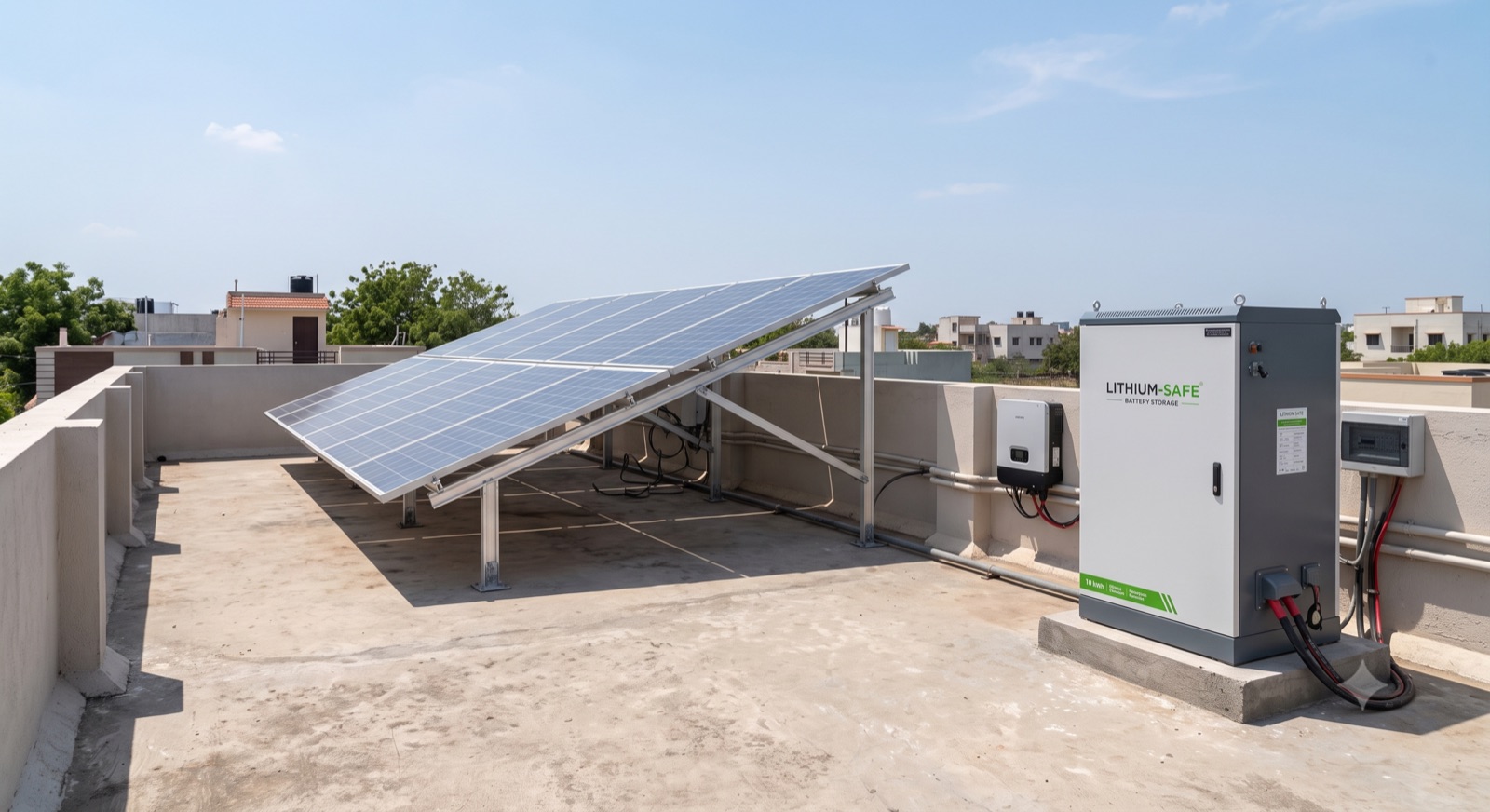
In Part 1, I made the case that a home battery-storage wave is coming to India: pulled in by a huge lead-acid base ready for a lithium upgrade, by export tariffs that already pay you only about half of retail, and by outages that never went away.
This is the harder half. A storage wave is only good news if we launch it well, and residential storage is one of the easiest energy products in the world to launch badly. I was involved in the global launch of Powerwall at Tesla, so I understand these challenges closely. This piece covers four things: why home batteries get bought for different reasons across markets and what that means for India, the honest pros and cons of a home battery, the deployment challenges that could derail the category, and what a responsible launch looks like.
Why Home Batteries Get Bought for Opposite Reasons
If you’re designing a residential storage product for India, this is the single most important thing to get right, and it’s where I most often see people copy the wrong playbook. Where a market lands is set by three things: how reliable the grid is, how high retail power prices are, and how much you’re paid to export surplus solar. That produces three camps.
Economics-driven markets buy for the bill. In Germany, retail power runs around €0.41/kWh, the highest in Europe, while the feed-in tariff has collapsed to under 8 cents, so a self-consumed solar unit is worth four to five times an exported one. Batteries there are almost pure self-consumption arbitrage, and attach rates on new residential solar have reached about 79% in Germany, 84% in Italy and over 90% in the Czech Republic (BOOSTESS; Reslink Energy). Nobody in Germany buys a battery because the lights go out, they don’t.
Reliability-driven markets buy for backup. India is one of them, and it isn’t alone. South Africa’s load-shedding crisis drove the same boom in home batteries, and there the motive was energy security rather than economics. In these markets a battery competes with a diesel generator, not a lower electricity bill.
Dual-driver markets buy for both. The US and Australia sit in the middle. In the US, California’s NEM 3.0 cut export credits by roughly 75% and pushed battery attach rates from about 11% to well over half (Solar.com; Dura-Foam), but an unreliable grid and wildfire shutoffs make resilience a real second motive (Harvard Salata Institute). Australia is similar: bill savings and VPP trading, now turbo-charged by a federal ~30% battery discount, sit alongside blackout protection as the draw (Clean Energy Council).
India is at the reliability end today. But the migration only runs one way: Germany was feed-in-driven until export rates fell below retail, then self-consumption took over. That’s the exact transition Part 1 described India entering as net metering erodes. So India buys for backup now and will buy for economics later, which means the product has to be built for the backup buyer it has today:
- Sizing follows critical loads and outage duration, not a time-of-use arbitrage window.
- The value proposition, channel and marketing are “energy security,” not “cut your bill.”
- The price ceiling is brutal. An Indian backup buyer benchmarks against a diesel genset or a lead-acid inverter, not a 20-year utility-bill calculation. That tight envelope is precisely where safety corners get cut, which is the danger the rest of this piece is about.
The company that wins Indian residential storage will build a backup-first lithium product for a hot climate at an aggressive price, not a rebadged American arbitrage box.
The Pros and Cons of a Li-Ion Home Battery
Pros:
- Energy security through outages, the core Indian value, and it’s real.
- Higher solar self-consumption, use your own midday generation in the evening instead of leaning on the grid, which matters more as export tariffs erode.
- A future revenue path, as India develops ancillary-services and demand-response markets, aggregated home batteries can eventually earn (the US virtual-power-plant model), though that’s years away here.
- Lithium’s lifecycle advantages, the durability and low-maintenance benefits laid out in Part 1.
Cons:
- High upfront cost with a weak standalone payback in India today, because cheap grid power and free-unit allowances already do much of the storage job for most grid-tied homes.
- No subsidy, the battery is excluded from Surya Ghar, so the household pays full freight (Business Today).
- Degradation and replacement cost, a real, and in India poorly understood, line item.
- Safety risk, lithium thermal runaway is a genuine hazard, amplified by heat, poor installation and cheap cells.
- Thermal derating in Indian ambient, 45°C summers stress both performance and safety.
- End-of-life and recycling, a waste stream India’s residential channel is not yet set up to handle.
The blunt summary: for most grid-tied Indian homes today, the rational answer is still no battery. That will change as export compensation erodes, and the industry needs to be ready to sell the right product when it does, not the cheapest one.
The Deployment Challenges
A utility-scale battery lives on a fenced site with fire suppression, monitoring and trained staff. A home battery lives on a garage wall, a terrace, or even in the living room, installed by whoever won the job, in 45°C ambient, with no O&M team and a family asleep on the other side of the wall. Every failure mode is worse in a home.
The biggest risk is a gap in the safety standards, and it sits at the system and installation level rather than the cell. At the cell level India is covered. BIS registration under the Compulsory Registration Scheme is mandatory for the lithium cells and batteries sold here (IS 16046 / IEC 62133-2). The gap is one layer up: the enclosure, the installed system, and the rules for how a battery is mounted and spaced in a home. India now has a serious storage safety framework: the CEA’s 2026 amendment (effective 1 April 2027) mandates two-fault-tolerant design, hazard detection, automatic fire suppression, spacing rules and third-party fire audits (Mercom India). But those requirements apply to installations above 650 volts, grid and container scale. Systems at or below 650 V, which is every residential home battery, are left to “relevant standards” still to be specified (Power Peak Digest; Energetica India). The exact tier PM Surya Ghar is about to flood is the one sitting in that gap. Contrast it with the mature US and global stack: UL 9540 certifies the system, UL 9540A is the thermal-runaway propagation test permitting bodies rely on, and NFPA 855 governs installation (UL Solutions).
India already learned a version of this lesson once, on two wheels. In 2022, a wave of electric-scooter fires, some fatal, pushed the government to task DRDO’s fire-safety lab (CFEES), with IISc Bengaluru, to investigate; it traced the fires to low-quality cells and modules and inadequate testing across temperatures (Business Today). Ola recalled 1,441 scooters, Okinawa 3,215 and Pure EV 2,000, nearly 6,700 in all (Electrive). The fix, the AIS 156 battery-safety standard, with its thermal-propagation and direct-flame fire-resistance tests, had existed on paper since 2020 but was only made mandatory after the fires (NRI Consulting). And the reputational damage outlived the recalls: by 2024 the consumer regulator had issued Ola Electric a show-cause notice and opened a class action over 10,644 complaints spanning manufacturing and battery defects (Business Today). That is the whole risk in one case study: cheap cells, thin testing, scale-fast, and a safety standard retrofitted only after the damage. A home battery is the same set-up, minus even the vehicle-battery rulebook: there is no mandatory residential-system equivalent of AIS 156 for a stationary home battery yet.
The other landmines:
- Price pressure pushing toward the cheapest cell, the tight backup-buyer price ceiling is a direct incentive to compromise on cell quality and BMS.
- Installer quality at scale, millions of units would be installed by a rapidly expanding, undertrained technician base. The failure most likely to hurt you is a bad install, not a bad cell.
- Imported cells and supply-chain risk, much of the pack supply is imported while domestic cell capacity builds, adding lead-time and quality-control variability.
- Heat, thermal design for 45°C ambient is non-negotiable, and it’s where LFP’s greater stability over NMC earns its place (Anern).
- Heavy rainfall in monsoon season, India experiences heavy rainfall and most of the region has high humidity, which could lead to water ingress if the product is not properly designed and certified.
- No fleet visibility, most home products ship with no telemetry, so a field problem stays invisible until it’s a fire.
Put these together and the nightmare writes itself: cheap, uncertified, imported home batteries, installed by undertrained technicians in extreme heat, with no monitoring, into a market with no mandatory residential safety code yet. It takes only a handful of house fires to erode public trust in the whole category.
What Makes a Successful Launch
For anyone building toward residential storage in India, and for the policymakers shaping the rules, here’s what a responsible launch requires. It’s the Powerwall playbook, adapted for India:
- Choose chemistry for the climate. LFP is meaningfully more thermally stable than NMC (Anern); in 45°C ambient that stability is a safety requirement, not a nicety. The cheapest cell is rarely the right cell.
- Engineer active thermal management. Keep the cells within their safe temperature band in Indian heat. In 45°C ambient, passive cooling often isn’t enough, and temperature control is a first-order safety system, not a comfort feature.
- Design for the monsoon. A home battery in India cannot be treated like indoor consumer electronics. With torrential rains and relative humidity frequently crossing 90%, passive weatherproofing fails. Manufacturers must design enclosures to a minimum of IP65 or IP66 ingress protection standards to completely isolate live cells from heavy rain and airborne moisture. Longevity of the product is another important aspect. The chassis must utilise marine-grade, anti-corrosive coatings to ensure structural integrity doesn’t degrade over a 10-to-15-year lifecycle.
- Propagation-test before you ship. Adopt UL 9540A-grade thermal-runaway testing and design the enclosure so a single-cell failure stays a single-cell failure. Don’t wait for India’s residential code to force it.
- Make the BMS fail safe. Two-fault tolerance, continuous voltage/temperature/current monitoring, automatic shutdown, the principles CEA now mandates for large systems should be your internal floor for small ones.
- Treat installer quality as a product feature. Certify, train and audit the installer network, and control commissioning the way you’d control a factory line.
- Ship telemetry from unit one. Connected monitoring turns a field problem into a data problem you can catch and fix across the fleet. This single capability separated our best years at Tesla from our worst.
- Pilot before you scale. System-test and run a controlled pilot before market launch. Release in phases, watch the data, fix what breaks, then scale. Every large residential-product recall I know of traces to scaling before the fleet data was in.
- For policymakers: close the sub-650 V gap now, with a residential-specific safety and installer-certification standard, before the wave. And if a battery subsidy does come, tie it to certified equipment and certified installers so incentive money buys safety, not just volume.
India has a rare advantage: it can adopt global best practice before its own mandatory residential standards arrive, rather than after a disaster forces the issue. The rooftop wave created the demand; the lead-acid base and eroding export tariffs will pull storage in behind it; and the safety window is still open. The company and the country that launches into that window with a backup-first product engineered to a standard higher than India yet requires won’t just win customers. It will define what “safe” means for the category, and pull the standards up behind it.
The batteries are coming to ten million Indian roofs whether the industry is ready or not. The only question is whether we launch them like the safety-critical fleet they are, or like an appliance and find out the hard way that they were never an appliance at all.
I spent over a decade in renewable energy, including seven years at Tesla and the global launch of Powerwall. I write on the operational side of energy storage, the part that starts after the product ships. If you’re building or regulating residential storage in India, I’d like to compare notes on doing it safely.
Missed Part 1? It makes the case for why this storage wave is coming at all: Part 1.
Sources
- Solar.com, California NEM 3.0 export-credit cut. https://www.solar.com/learn/nem-3-0-proposal-and-impacts-for-california-homeowners/
- Dura-Foam, California battery attach rates. https://dura-foam.com/nem-3-california-solar-explained/
- BOOSTESS, Europe residential storage drivers; attach rates. https://www.boostesspower.com/our-latest-blogs/what-are-the-drivers-for-battery-storage-deployment-in-europe-2025/
- Reslink Energy, Germany self-consumption economics. https://www.reslink.org/blogs/germany-solar-battery-storage-2026-epc-guide/
- Harvard Salata Institute, economics vs backup drivers; US grid reliability. https://salatainstitute.harvard.edu/germanys-battery-boom-reframes-the-energy-transition/
- Clean Energy Council, Australia home-battery drivers. https://cleanenergycouncil.org.au/advocacy/its-time-to-back-batteries
- Business Today, battery excluded from PM Surya Ghar subsidy. https://www.businesstoday.in/latest/trends/story/can-rooftop-solar-provide-uninterrupted-electricity-learn-why-grid-connection-is-essential-534712-2026-06-04
- BIS CRS, Cells and Batteries FAQ (IS 16046 / IEC 62133-2 mandatory). https://www.crsbis.in/BIS/app_srv/tdc/gl/docs/FAQs-Cells-and-Batteries-14-Nov.pdf
- Mercom India, CEA 2026 BESS safety rules. https://www.mercomindia.com/cea-notifies-rules-on-safety-framework-for-battery-energy-storage-systems
- Power Peak Digest, CEA BESS safety rules; 650 V threshold. https://powerpeakdigest.com/cea-notifies-bess-safety-rules-effective-april-2027/
- Energetica India, CEA 2026 rules; two-fault tolerance, fire audits. https://www.energetica-india.net/news/cea-issues-2026-bess-safety-rules-mandates-two-fault-tolerance-and-fire-audits-from-april-2027
- UL Solutions, UL 9540A thermal-runaway test method. https://www.ul.com/services/ul-9540a-test-method
- Business Today, DRDO/CFEES EV-fire findings; manufacturers summoned. https://www.businesstoday.in/auto/story/ev-fires-drdo-lab-submits-report-ola-electric-okinawa-others-summoned-by-govt-334651-2022-05-23
- Electrive, 2022 EV scooter recall figures (Okinawa 3,215, Pure EV 2,000, Ola 1,441). https://www.electrive.com/2022/05/04/electric-scooter-recall-in-india/
- NRI Consulting, What’s behind the EV fires; AIS 156 / AIS 038 Rev 2. https://india.nri.com/media/l4amsz34/what-s-behind-the-ev-fires.pdf
- Business Today, CCPA show-cause notice to Ola Electric; 10,644 complaints. https://www.businesstoday.in/auto/story/ola-electric-slapped-with-show-cause-notice-following-surge-in-consumer-complaints-449121-2024-10-07
- Anern, LFP vs NMC thermal stability; UL 9540A residential ESS. https://www.anernstore.com/blogs/diy-solar-guides/ul9540a-myths-reality-residential-ess
Figures as reported 2022–2026.